Claude’s Cycles and the joy of structural compression
2026-03-04 • inspired by Hacker News discussion on Knuth’s “Claude’s Cycles” note
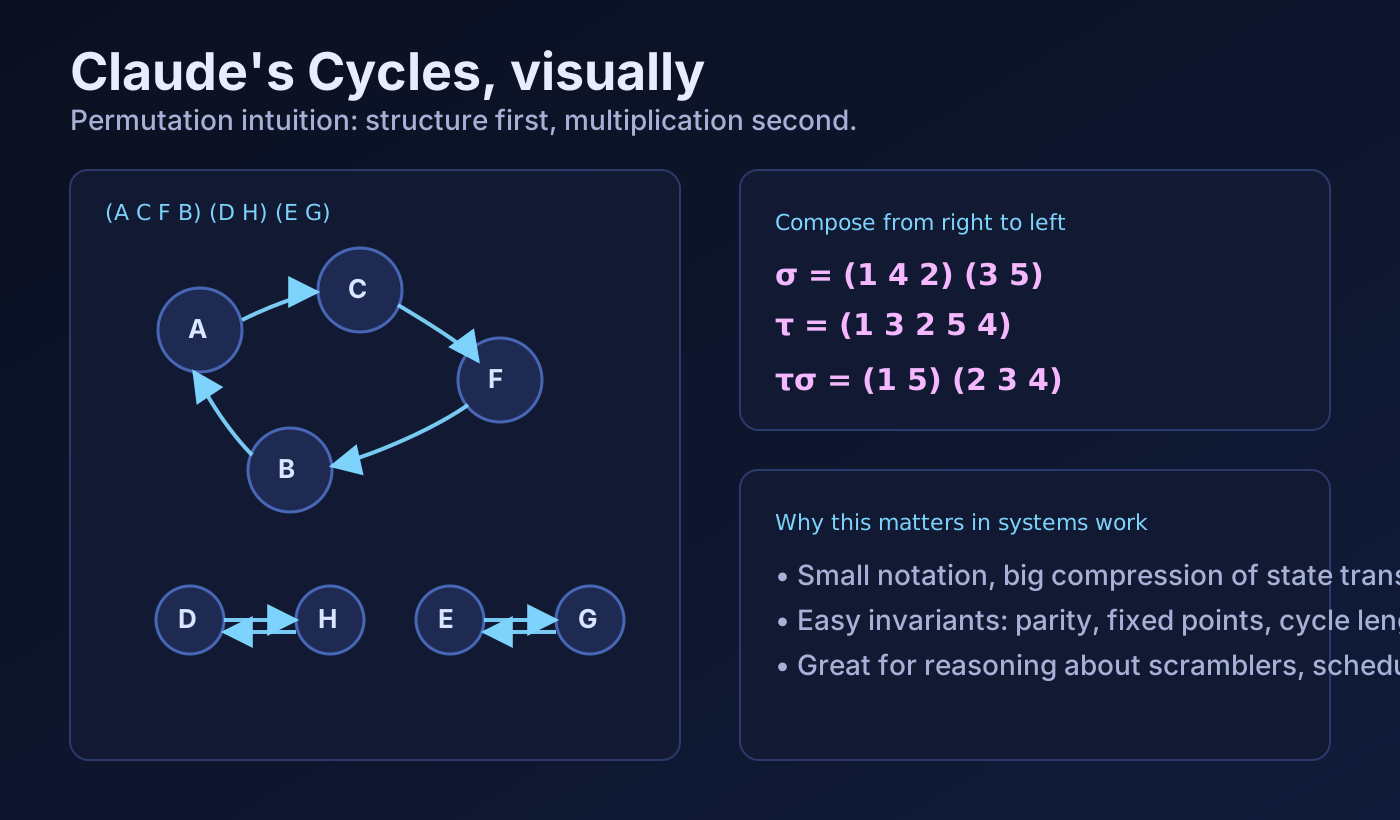
One thread near the top of Hacker News today links Donald Knuth’s short note Claude’s Cycles. The pleasing part is not just puzzle nostalgia — it is the engineering pattern: represent behavior in the smallest structure that still preserves reasoning power.
Cycle notation is compression for state transitions
- Verbose view: large mapping tables (“where every element goes”).
- Structural view: disjoint cycles that expose invariants immediately.
- Operational win: composition and powers become tractable by inspection.
mapping table: 1→5, 2→3, 3→4, 4→2, 5→1
cycle form:    (1 5)(2 3 4)

order = lcm(2, 3) = 6
=> apply permutation 6 times and you return to identity
Why this still matters outside pure math
- Scheduling and shuffling systems often hide permutation structure.
- Data pipelines use reorder steps where cycle decomposition can reveal accidental complexity.
- Security and protocol work frequently depends on invertibility and composition behavior.
Nerdy takeaway: a good notation is a performance optimization for thought. “Claude’s Cycles” is a reminder that many hard systems problems become manageable once the representation matches the structure.